Why Botty Reviews Deserve a Careful Fact-Check
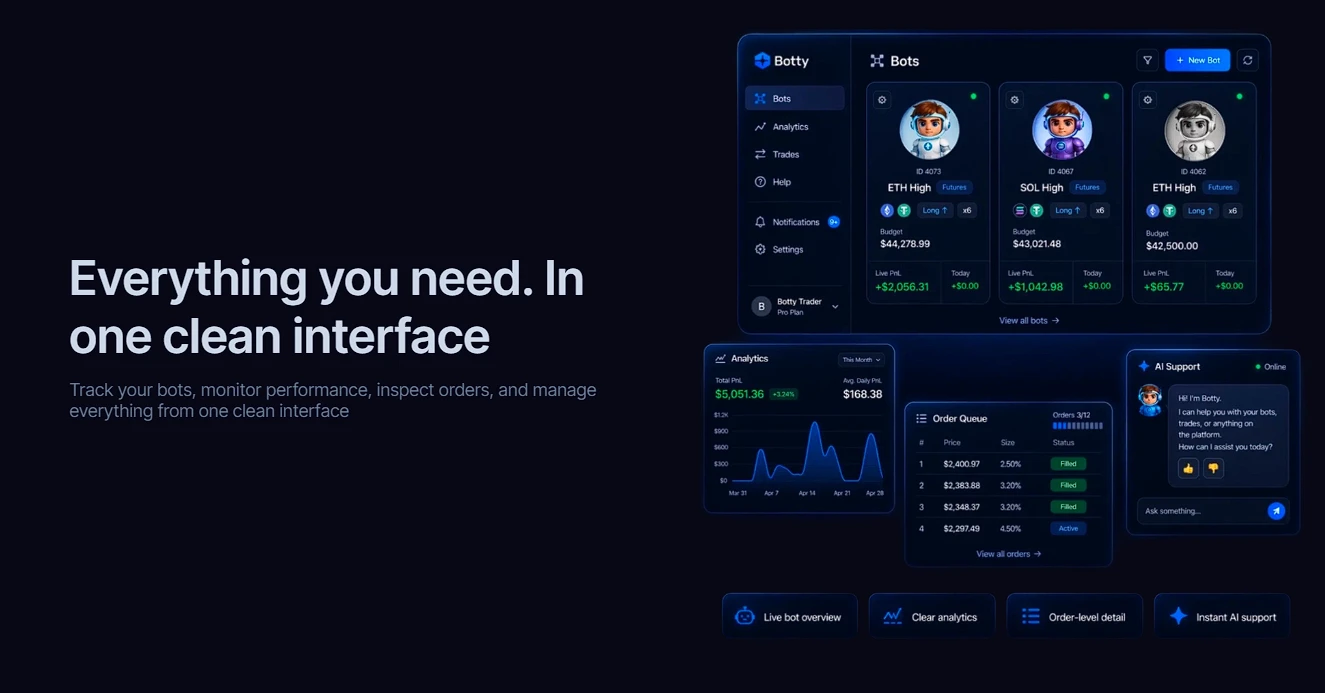
Botty is a platform for automated trading in cryptocurrency and stocks that connects to an exchange through a wallet signature and executes preset or custom strategies on spot and futures markets. The platform highlights several features, including rules-based automation, a non-custodial model, historical performance data for ready-made templates, transparent analytics, and an activity-based fee structure.
This article examines Botty claim by claim, comparing the platform’s documented mechanics with recurring themes found across independently collected user reviews. The purpose is to provide a clear picture of how the platform works, what users report, and which details can be confirmed from the available materials.
Claim One: Botty Offers Fully Automated Trading
CLAIM: Botty lets users connect an exchange account and run a bot that trades automatically, without manual order placement.
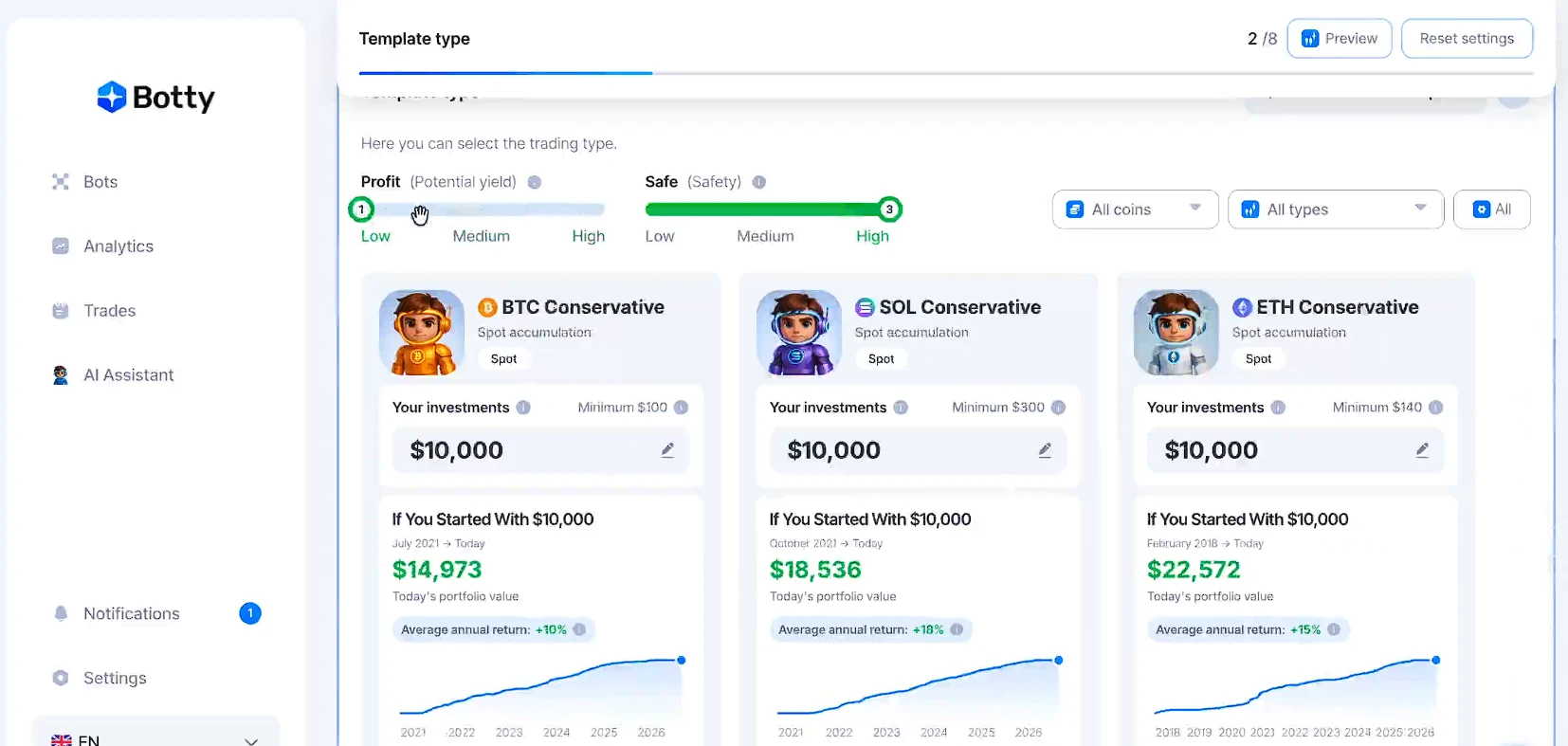
WHAT THE MATERIALS SAY: A user selects a ready-made template or configures custom settings, connects an exchange account through a wallet signature with trading-only permissions, and the bot opens and closes trades according to those parameters, operating continuously rather than on a manual schedule.
WHAT CAN BE VERIFIED: The mechanics described are standard for algorithmic trading tools: a rules-based system executes trades once conditions are met, without a human clicking “buy” or “sell” for each order. This workflow matches how comparable bots function elsewhere in the industry.
WHAT THIS MEANS IN PRACTICE: Automation removes the need to place every order manually and helps the selected strategy operate consistently according to predefined rules. Actual results can vary depending on the chosen template, its parameters, and market conditions.
CONCLUSION: Automated execution is a clearly documented core function of Botty. The platform is designed to apply a selected strategy continuously without requiring the user to monitor charts and place every trade manually.
Claim Two: Botty Connects Through a Wallet Signature Rather Than Holding Funds
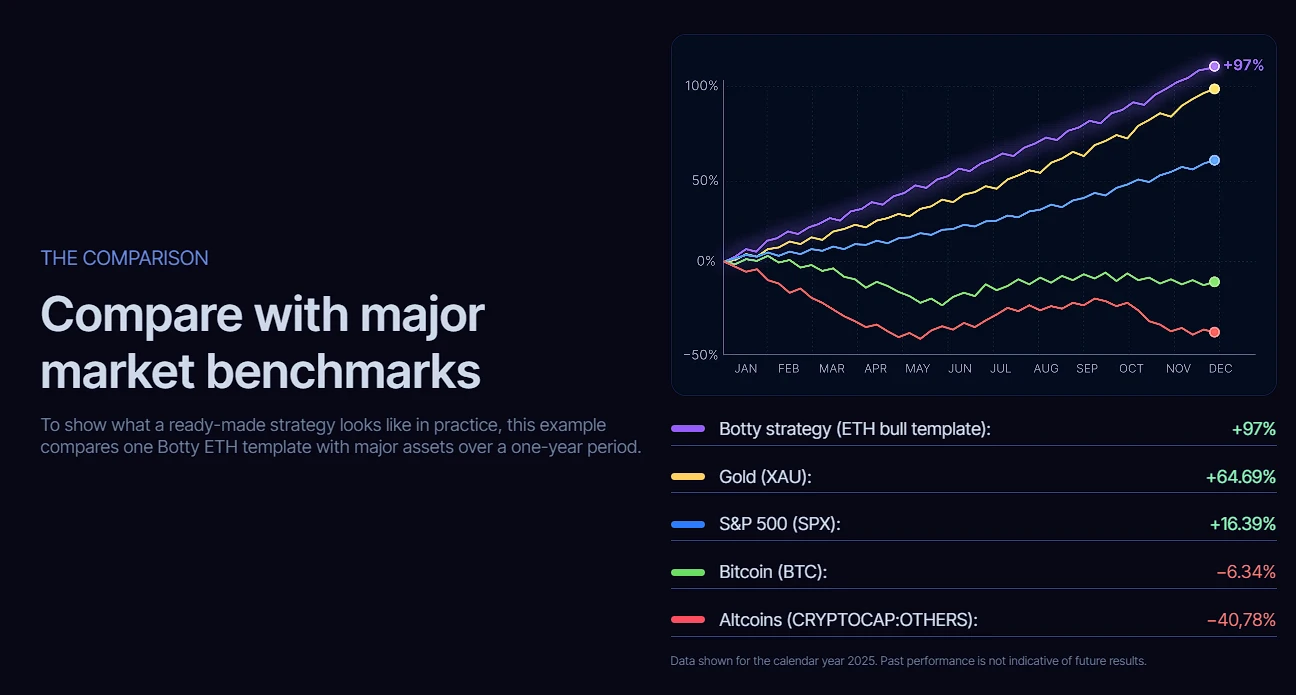
CLAIM: Botty is non-custodial. It does not take possession of user funds; it connects to the user’s own exchange account through a wallet signature and receives permission to open and close trades without withdrawal access.
WHAT THE MATERIALS SAY: Botty uses Hyperliquid’s Builder Code mechanism. The connection is authorized through a wallet signature scoped to trading permissions only, while the restriction on withdrawals is enforced at the exchange level. Funds remain on the user’s own exchange account throughout the process.
WHAT CAN BE VERIFIED: The permissions granted to Botty can be reviewed during the connection process. This makes the separation between trading rights and withdrawal rights visible to the user. Botty has also completed an independent security audit by DigVel, with information about the audit available on the platform’s website.
CONCLUSION: Botty operates as a wallet-connected automation layer rather than as a custodial exchange or wallet. Its role is limited to executing trades according to the selected parameters, while the user’s assets remain on the connected exchange account.
Claim Three: Spot Trading Templates Avoid Liquidation Risk
CLAIM: Botty’s spot trading bots cannot be liquidated because the user always ends up holding the underlying asset.
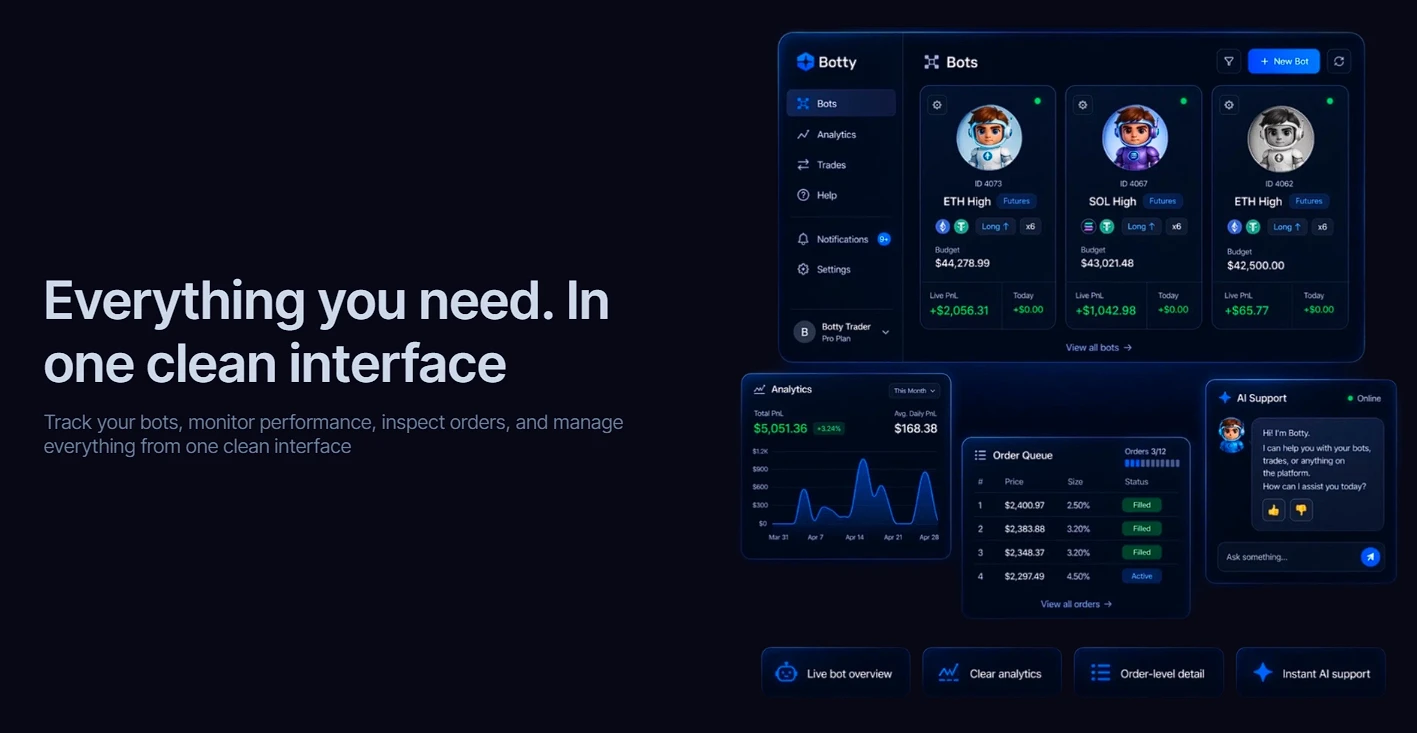
WHAT THE MATERIALS SAY: According to the brand materials, a spot bot buys the actual asset, for example, ETH, and averages the purchase price as the price declines, later closing the position for a profit on a rebound. Because the user holds the real asset rather than a leveraged contract, the materials state there is no liquidation mechanism in spot trading. If the market stays down, the user can stop the bot and hold or redeploy the asset elsewhere.
WHAT CAN BE VERIFIED: This is an accurate description of how spot markets work generally: buying an asset outright does not involve borrowed leverage, so it carries no liquidation mechanism the way a leveraged futures position does. That underlying mechanic is verifiable independently of Botty.
WHAT THIS MEANS IN PRACTICE: Spot templates trade the underlying asset without using credit leverage. Their results still depend on the asset’s price movement and the selected template parameters, but they provide a more conservative alternative to futures templates.
CONCLUSION: The claim that spot templates do not involve liquidation is mechanically accurate. Botty presents them as the more conservative option for users who prefer trading without leverage.
Claim Four: Futures Templates Use Built-In Risk Controls
CLAIM: Botty’s futures templates use staggered order grids, capped leverage, position-sizing rules, and predefined parameters instead of relying on continuous manual management.
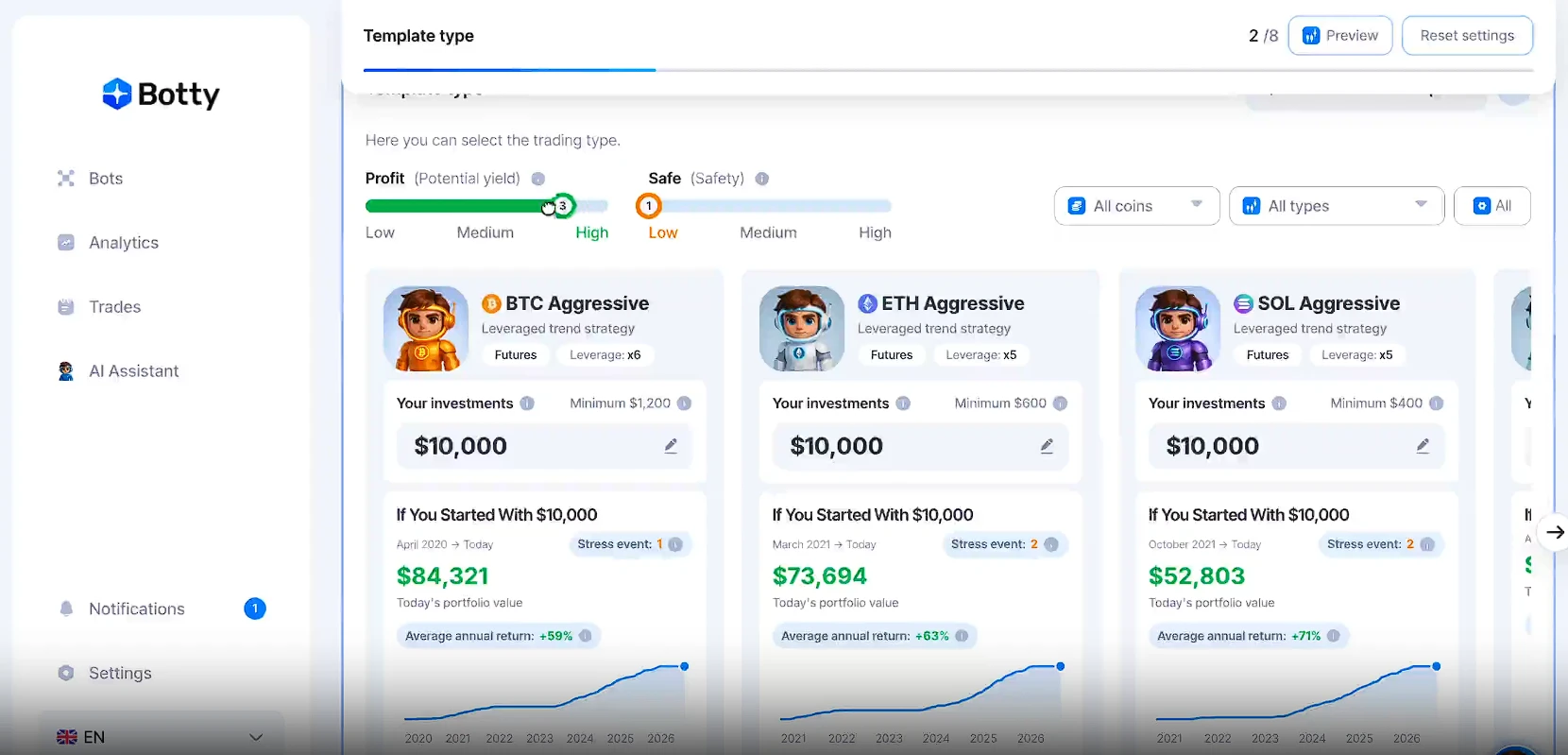
WHAT THE MATERIALS SAY: The templates trade leveraged contracts while limiting maximum leverage and controlling how much of the allocated budget is deployed. Orders are placed according to a predefined grid, allowing the bot to manage entries and exits systematically.
WHAT CAN BE VERIFIED: Leverage limits, partial-budget deployment, and staggered order placement are established risk-management tools in derivatives trading. The available materials consistently describe these controls as part of Botty’s futures-template logic.
CONCLUSION: Botty’s futures templates apply a structured, rules-based approach with built-in controls. Users can choose between conservative, balanced, and aggressive templates according to their experience and preferred risk profile.
Claim Five: Ready-Made Templates Include Historical Performance Data
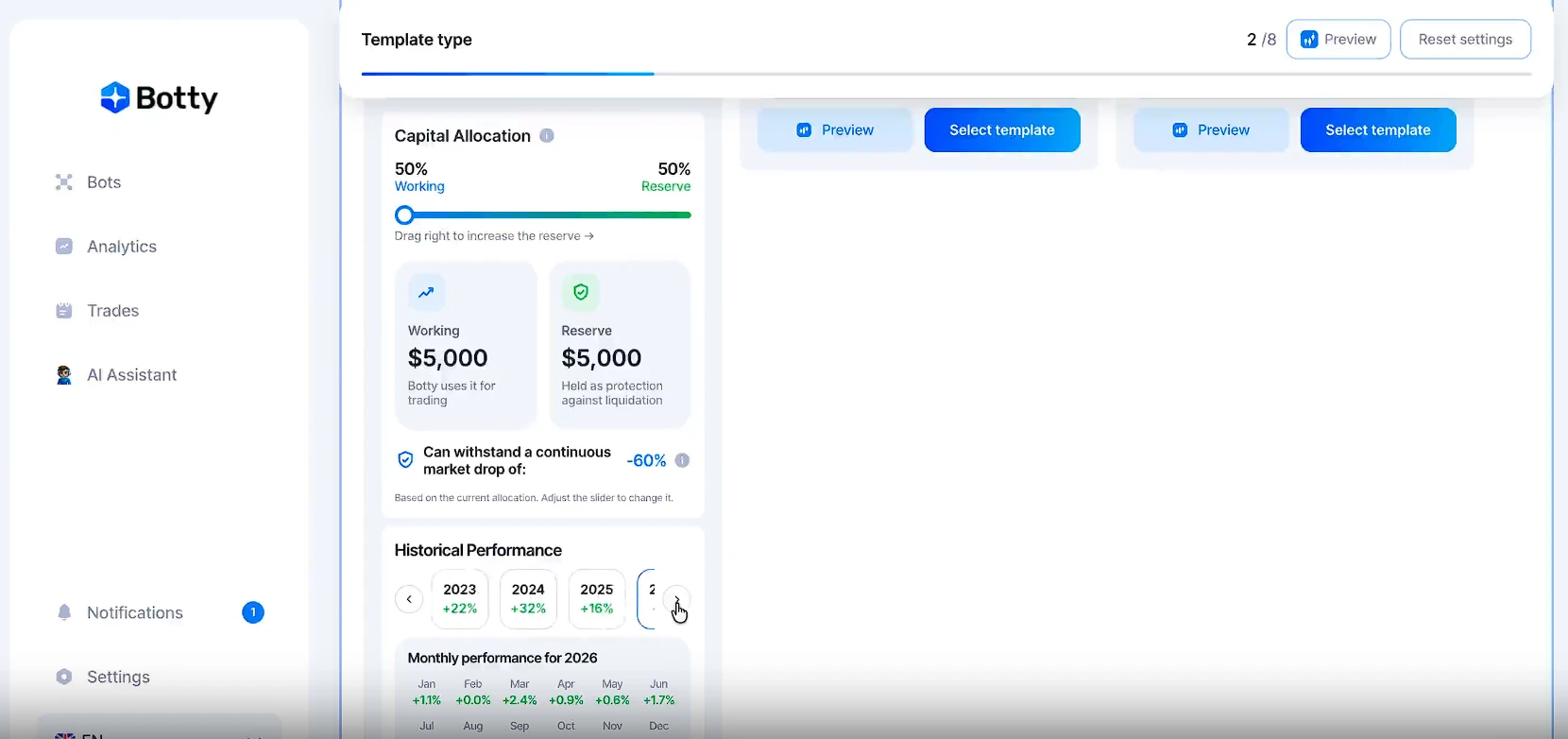
CLAIM: Botty’s ready-made templates display historical performance based on backtesting across more than five years of market data.
WHAT THE MATERIALS SAY: Users can review the historical results shown for each ready-made template and compare them with the template’s parameters and risk level before making a selection.
WHAT CAN BE VERIFIED: Historical performance is displayed as part of the template information. Botty does not currently provide a separate feature that allows users to run their own backtests with custom settings; the displayed figures are based on testing conducted for the ready-made templates.
CONCLUSION: The historical data gives users an additional reference point when comparing templates. It is presented as information about how a particular strategy performed over previous market periods rather than as a fixed result for every user.

Claim Six: Botty Shows Historical Returns of Approximately 7% to 58%
CLAIM: Botty’s ready-made templates show historical annual returns ranging from approximately 7% to 58%.
WHAT THE MATERIALS SAY: The figures are based on more than five years of backtesting data and vary according to the selected template and its parameters.
WHAT CAN BE VERIFIED: The historical percentage is displayed for each template as one of several comparison points, together with its trading approach and risk level.
CONCLUSION: The range describes the historical performance of specific templates rather than an average result across all users. It helps users compare the available options before choosing a template.
Claim Seven: Botty Uses an Activity-Based Fee Model
CLAIM: Botty uses an activity-based fee model rather than charging a fixed monthly subscription.
WHAT THE MATERIALS SAY: Botty’s fee is built into Hyperliquid’s trading fee and applies when the bot actively executes trades. When the bot is idle, there is no Botty fee.
WHAT CAN BE VERIFIED: The model is tied to trading activity rather than continued access to the platform. Several reviewers mention the absence of a fixed monthly subscription as one of the features they appreciate.
CONCLUSION: Botty’s activity-based fee structure means users pay in connection with trades executed by the bot rather than paying a recurring subscription regardless of whether the bot is active.

Claim Eight: Botty Is Accessible to Complete Beginners
CLAIM: Botty is designed so that users with no trading experience or crypto background can set up a working bot in minutes.
WHAT THE MATERIALS SAY: The platform offers ready-made templates with clear parameters and AI-powered guidance that helps users understand settings and configure the bot without requiring extensive prior trading experience.
WHAT CAN BE VERIFIED: The independently sourced reviews provide direct support for this claim. Multiple users describe the initial setup as relatively quick and highlight the clear template structure and helpful AI explanations. The review sample includes people with limited technical backgrounds and users who do not have time to monitor charts throughout the day.
CONCLUSION: The accessibility claim is supported by a recurring pattern across independently sourced reviews. Ready-made templates and AI guidance simplify the initial configuration and help users understand how the selected strategy works.
Claim Nine: Botty’s Origin Traces to a Large Crypto Education Background
CLAIM: Botty grew out of an existing crypto-education ecosystem that had already worked with a large student base before the trading platform launched.
WHAT THE MATERIALS SAY: The brand materials describe Botty’s background as emerging from one of the larger crypto education operations in the region, citing a student base of 40,000+ people who went through paid educational programs, with the same trading algorithms later carried into the Botty platform.
WHAT CAN BE VERIFIED: The materials are internally consistent in describing an education-to-product pipeline, where strategies were reportedly developed through an educational audience before being packaged into the bot. The exact size of the educational audience is presented as background information supplied by the company.
CONCLUSION: The education-background claim provides context for the development of Botty’s methodology and explains how the strategies were reportedly tested and refined before being introduced on the platform.

What Botty Reviews From Independent Sources Actually Show
The review sample examined for this article draws from independently sourced, publicly posted reviews written in English, Russian, and Ukrainian, collected from open review platforms across the internet rather than supplied or curated by the company. Several recurring themes appear.
The most frequent is emotional relief from manual trading decisions. Many reviewers describe a prior pattern of panic-selling during drops or buying into hype and describe the bot’s fixed, rules-based execution as removing that behavior from the equation. Several frame the appeal not as a specific promised result but as consistency: small, repeated gains rather than a single large win, with more than one reviewer noting that the results were modest but that consistency itself was the value.
A second theme is the non-custodial structure, with multiple reviewers independently describing it as the reason they trusted the platform enough to connect their exchange account, citing that their assets remained in their own account.
A third theme is accessibility, with relatively quick setup and preset labels that made sense without prior trading knowledge. A fourth is transparency of trade history, with reviewers describing the ability to see every trade logged and understand why it happened, contrasting this with prior copy-trading experiences.
Reviewers also described mechanics consistent with the platform’s own documentation: grid-based spot and futures bots, conservative, balanced, and aggressive templates, historical performance influencing template selection, AI guidance, and an activity-based fee rather than a flat subscription.
It is also worth noting that no clearly negative reviews appeared among the independently sourced reviews collected for this analysis. This should be understood as a characteristic of the specific sample rather than a statement about every user of the platform. Reviews describe individual experiences, and several users mentioned that they began cautiously while becoming familiar with how Botty works.
Botty Reviews and Claims: A Balanced Final Assessment
Pulling the individual claims together, several aspects of Botty are consistently supported by the available materials and user reviews. Botty operates as a wallet-connected, non-custodial platform for automated trading in cryptocurrency and stocks. Through Hyperliquid’s Builder Code mechanism, the platform receives trading-only permissions without withdrawal access, while funds remain on the user’s own exchange account. Botty has also completed an independent security audit by DigVel.
The platform provides ready-made spot and futures templates with conservative, balanced, and aggressive approaches. Users can review the historical performance of each template based on more than five years of backtesting data, with displayed annual results ranging from approximately 7% to 58% depending on the template and its parameters. Botty does not currently offer a separate feature for users to run custom backtests.
The available reviews show recurring themes across three languages and multiple independent platforms: relatively quick setup, reduced emotional involvement in trade execution, visible trade history, helpful AI guidance, and appreciation for the absence of a fixed monthly subscription. Botty’s activity-based fee is built into Hyperliquid’s trading fee and applies only when the bot actively executes trades.

FAQ
Is Botty a custodial platform that holds user funds?
No. Funds remain on the user’s own exchange account, while Botty connects through a wallet signature with trading-only permissions and no withdrawal access. The connection uses Hyperliquid’s Builder Code mechanism, and the permissions can be reviewed during the connection process.
Can users run their own backtests in Botty?
Botty does not currently offer a separate feature for running custom backtests. Users can view the historical performance of each ready-made template based on more than five years of backtesting data and use it to compare available strategies.
Are the Botty reviews used in this analysis provided by the company?
No. They were collected from independent, publicly accessible review platforms across the internet in English, Russian, and Ukrainian, rather than curated or supplied by Botty as a company sample.